
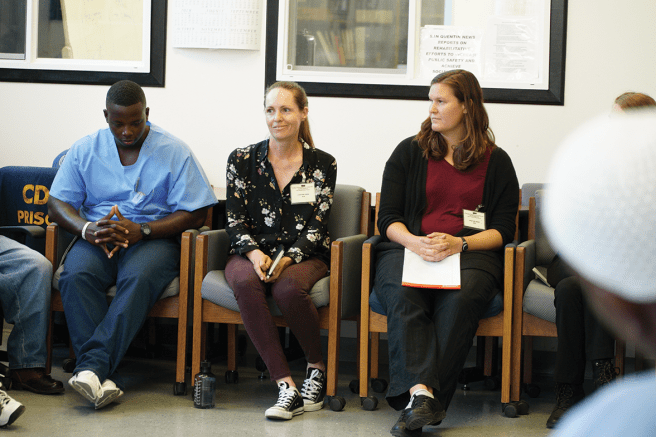
Teaching inside of a prison has a number of challenges, and most are completely unrelated to the subject matter. Among the most apparent is the element of privilege: because I am not incarcerated, I can go home. At the end of class, I can walk across the yard, out the gate, get in my car and drive away. I can choose where I live, eat, work, and attend school. I can choose to travel locally, nationally, and internationally. I can communicate with my family, friends, and colleagues on my own terms. I can, in most hypothetical cases, advocate for my own well-being and my rights without fear of retaliation or harm. This privilege, which is deeply embedded in my everyday life, is a created by my intersecting identities, which result social positionality as a white, cisgender, straight woman who was born in the United States to college-educated parents.
To even conceive of teaching inclusive courses in prison would be incredibly difficult without the willingness to acknowledge and discuss race, racism, whiteness, and white supremacy. It is standard practice for incarcerated individuals to self-segregate according to race, for numerous political reasons that expand beyond the scope of this project. And of course, the number of incarcerated persons who are non-white (mostly Black or Hispanic) far exceeds the number of white people who are in prison. This is reflected in my current class population: of the 37 total students enrolled in my two classes this semester, 21 are Black and seven are white (the remaining men are either either Asian or Hispanic). As a result of navigating the teaching experience as a white woman whose students who are predominately men of color, I find the assertions put forth by Asao Inoue to be absolutely imperative when considering how to best understand student perspectives on literacy. In the introduction to Labor Based Grading Contracts: Building Equity and Inclusion in the Writing Classroom, Inoue discusses the importance of acknowledging the presumed authority and power that inherently accompany teaching as white supremacist practice. In anticipation of protest by teachers (especially from those of us who are white), Inoue explains that teachers must stay the course and reflect on our positionality to recognize that the systems by which we operate are not neutral (p. 6). Further, Inoue urges teachers who feel that they are being unfairly accused of perpetuating white supremacist narratives to consider, then, the affects of such practices on their students who belong to marginalized populations, daring teachers to “suffer with us” (p. 6).
It has become apparent to me that teaching, especially teaching reading and writing, serves to reproduce practices and conventions that effectively marginalize entire demographic populations. Anecdotally, many of my students feel that they have been left out of the system of education due to their backgrounds: as men of color, or who grew up in a low-income household, had one or both parents incarcerated, whose lived experiences do not mirror those understood to be normal of members of our society. Statistically, this is represented by the findings such as that only 52% of black males graduate from high school in four years, compared to 78% of white male students; (Schott Foundation for Public Education, 2012, as cited in Dancy, 2014). The exclusion of marginalized people from literacy is a result of the deeply ingrained ideological values and resulting practices that McCormick and Waller discuss in their article, Text, Reader, Ideology. By employing critical approaches to reading and writing, students are able to develop the tools with which to develop their own student identities, rather than parroting the ideas of the dominant culture.
When we as teachers participate (unknowingly or otherwise) in a societal structure that has been constructed to serve some students and exclude others, we risk training students to remain complicit in an oppressive colonialist society, which perpetuates the unjust conditions that create circumstances for continued marginalization. (hooks, Teaching Critical Thinking). Whether or not we like to acknowledge it, teaching is a political act itself (Freire, p. 5).
So, my messy and incomplete conclusion is, we, as educators, have to be open to change. Because students have been indoctrinated into this system of power as if it’s the normal way of operating, just as the rest of us have, teachers need to be mindful that students will likely resist deviation from traditional academic structure, because the traditional structure signifies legitimacy. I have to be willing to have the hard conversations around power and race and oppression, even if doing so feels like I’m implicating myself. I have to be willing to consider the worlds of my students, and to help facilitate their understanding of academic conventions without presenting them as superior. I have to be an advocate for students who are usually not represented in the greater academic community, which generally means that I have to contextualize the academic conventions typical of a college English classroom (for example, literary analysis, persuasion, style, voice, and rhetorical choices) in ways that value student experience.
And, most of all, I have to care. Sometimes that means showing up to teach on Sundays evenings for a couple hours, sometimes it means reading the essays I think are brilliant, and telling the students how great they are. Other times, I have to care in ways that might seem inconvenient, like sitting down with a student who has a hard time reading from print, and reading aloud to him for an hour and a half after class. Admitting, while reading aloud with said student, that I don’t know how to pronounce “usurpations” in the Declaration of Independence. Letting students know that it’s okay to say when I don’t know something. Growing up, I learned that it was definitely not okay to not know what I’m talking about, especially if it’s school-related, and I have to remind myself that it’s important for my students to see that learning is a process and we’re never done. Because I care more about them than I do my ego, I put my own baggage aside and own up when I don’t have the answers. Guess what? Life goes on. We still don’t have a definitive answer about the pronunciation of “usurpations” but over the course of our meeting, that student and I shared some laughs, drew some connections between readings, talked about historical context, and created his outline for his final essay. That’s all much more important than having the “right” answer, and my student, I believe, felt the same. Grades and degrees come and go, but knowing someone has your back–that’s priceless. I can only hope that my students believe me when I tell them I wouldn’t be there if I didn’t care about them.

 Alex Naeve
One thought on “…It’s Complicated”