
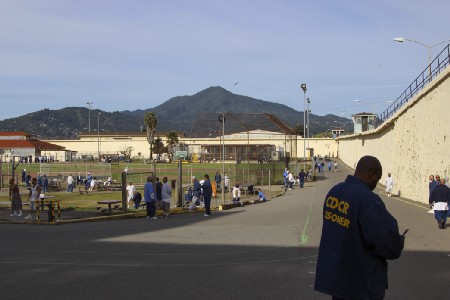
Students in English 99B, Fall 2019
The following examples of student work are offered to provide readers with an idea of San Quentin students’ backgrounds, which are vastly diverse. I feel that acknowledging my privilege as a non-incarcerated person is important here, because I’m speaking for students who can’t simply type up a blog post and make it public. Therefore, I want to represent a few students’ words as they chose to convey their own messages to my co-instructor and myself (with permission from students).
One of our first assignments of the semester invites students to write a letter to us, their teachers. Students are prompted to share their challenges and successes in learning, prior education experiences, and their reading and writing practices in everyday life. These letters are useful for several reasons, one of which is that students are invited to share more about themselves than their obvious status as an incarcerated person. I think that this not only allows teachers to see students as complex humans (rather than inmates) but it allows students to draw attention to their own lived experiences and see these as both valuable and relevant in a classroom context. In these letters, I learned that one of my students is currently writing a novel that takes place in Hong Kong, another was born in Thailand and worked as a sushi chef in Hollywood for several years. One student is married to a middle school teacher and attended Cal Poly where he majored in engineering. Another just completed his GED and wasn’t so sure about this whole college thing. The letters allow us to read our students as people, to see beyond the state-issued blue shirts and recognize the vast differences between each person.
Note: I want to call attention to the fact that, because incarcerated students do not have access to the internet, they are unable to access this digital essay. I have compiled all of its components into a formatted PDF, so that it can be easily printed in its entirety for incarcerated students. This is not a perfect solution, but I felt that it was a necessary step toward equitable access to education.
The articles and reports that are accessible through the hyperlinks in the text of this essay give readers access to printable documents that could be shared. All of the hyperlinked articles are stored on my Google Drive.
The writing shared is posted with explicit permission from students, who were provided with a description of this assignment and an explanation of the context in which their words would be used. Any student whose name appears here gave explicit permission (and in some cases, requested) to have his full name included with his work.
J.D.
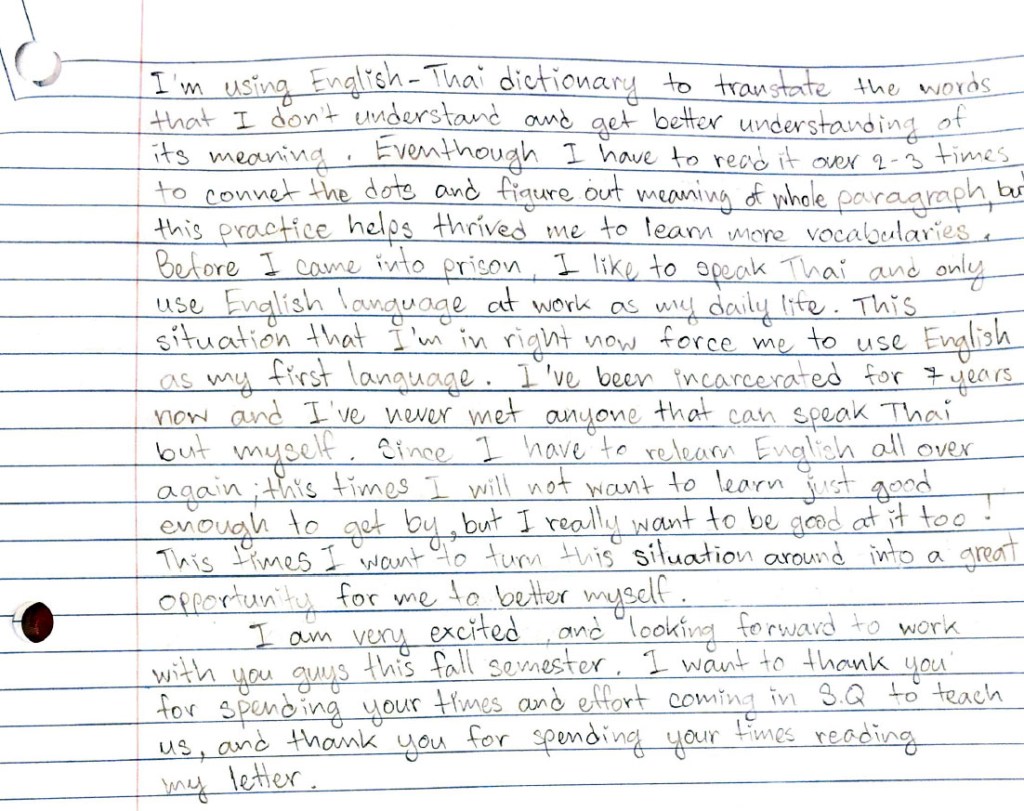
T.K.
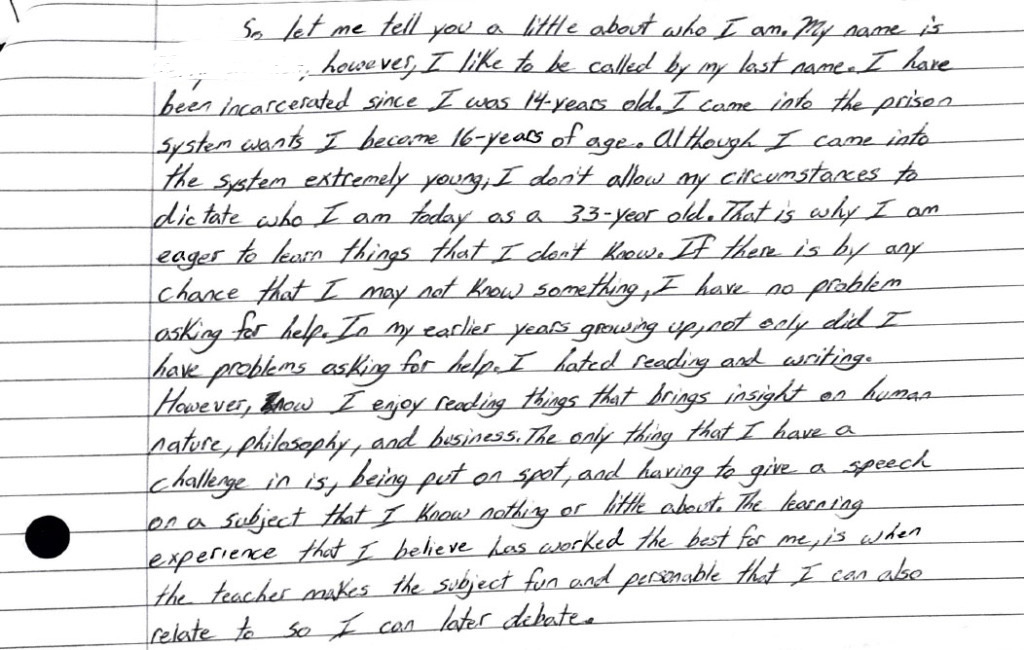
P.K.
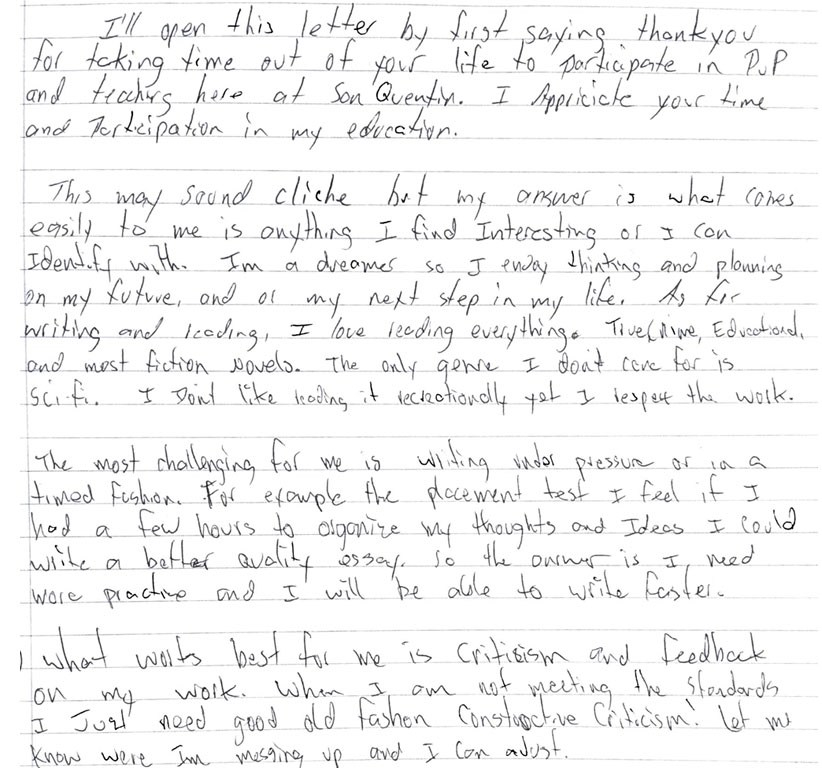
N.B.

Further reflections by MTC students
The prison population at San Quentin State Prison
- 4,198 men are housed at San Quentin (weekly report , CDCR, 12/4/2019.) (“Men” refers to individuals who are considered by the state to be biologically male because of sex assigned at birth)
The prison population in California
According to the PPIC (Public Policy Institute of California)’s report published in 2019:
- Approximately 115,000 people are housed in California’s 35 state prisons
- 28.5% of adult men incarcerated in California are Black, which is 4,236 per 100,000 people (the imprisonment rate for white men is 422 per 100,000)
- 25.9% of incarcerated women are Black (5,849 women are imprisoned in California, total)
The prison population in the United States
According to a report published by the Sentencing Project in 2019:
- 2.2 million people are incarcerated in the United States
- 60% of the incarcerated population are people of color
- Approximately 1 out of 12 Black men in their thirties is in prison or jail
- Black men are 6 times more likely than white men to experience incarceration
- Hispanic men are 2.7 times more likely to experience incarceration than white men

 Alex Naeve
One thought on “The Guys in Blue: Students at San Quentin State Prison”