
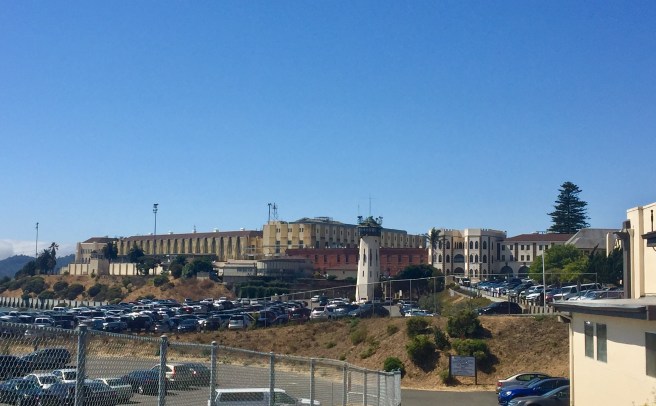
One of the first things I noticed when I began teaching at San Quentin in September 2018 was the remarkable similarity to, well, any other classroom. Other than the razor wire visible from the window, and the padlocks on the metal cabinets that lined the back wall of the room, there wasn’t much about the space that made me immediately think, “prison.” There are, however, a few key differences, which I detail below. For information about the incarcerated population in the United States and in California specifically, please see the Guys in Blue.
At the time of writing this essay, I have taught both communication studies and pre-college English twice with the Prison University Project (PUP) at San Quentin State Prison. All of the classes offered by PUP meet twice per week and are team-taught by two or more instructors. Instructors of credit-level courses must hold an advanced degree (master’s or higher) in a closely related field, and instructors of pre-college courses must have a bachelor’s degree at minimum, with graduate experience preferred.
Okay, there are a few differences
- Students do not have computers. Students are unable to access the internet, and rely on printed materials from teachers or the prison’s library when collecting research. While some students have access to basic word processing programs through their jobs and can hand in typed work, many do not, and have to write their papers by hand.
- Students cannot contact teachers directly. The institution’s rules do not allow students to contact teachers outside of class, and teachers cannot hold regular office hours.
- Students sometimes miss class due to extenuating circumstances. Students may be called to a medical appointment or parole board hearing without having a say in the day or time of the appointment.
- Lockdowns, quarantines, and unforeseen circumstances happen. In other words, classes might be canceled with very little notice, and teachers probably won’t know why. Or, teachers won’t be allowed into the prison if there is limited visibility due to the weather (fog, for instance, is a recurring problem).
- The only technology available in the classroom is a TV/VCR/DVD player combination. No cell phones, no laptops, and no recording devices are allowed. All media shown in class must be approved in advance by the CDCR. .

 Alex Naeve
One thought on “What’s it like, teaching in prison?”