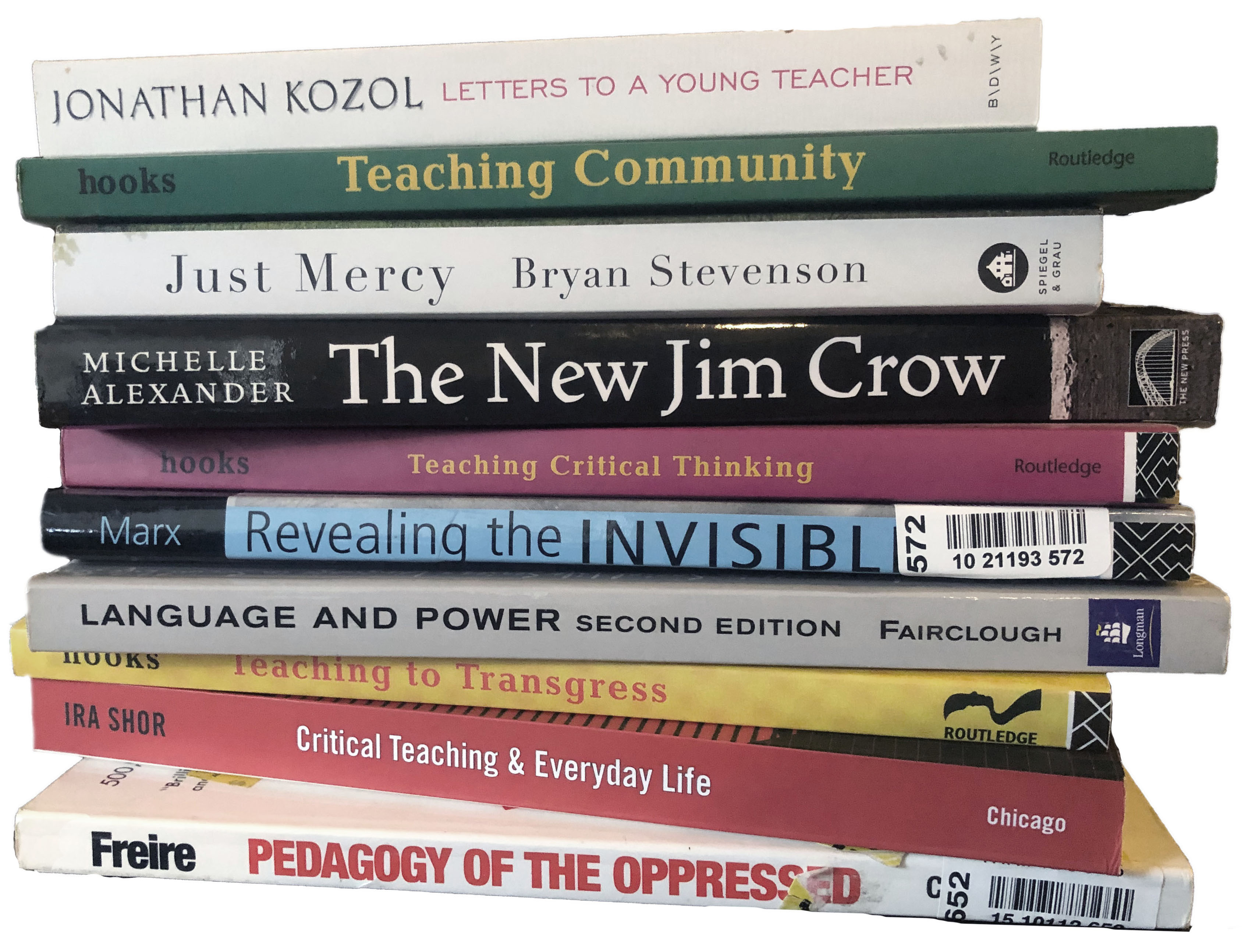
What’s it like, teaching in prison?

Photo by Alex Naeve

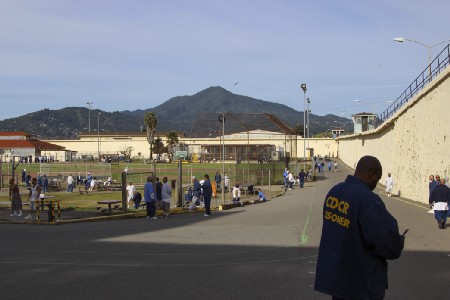
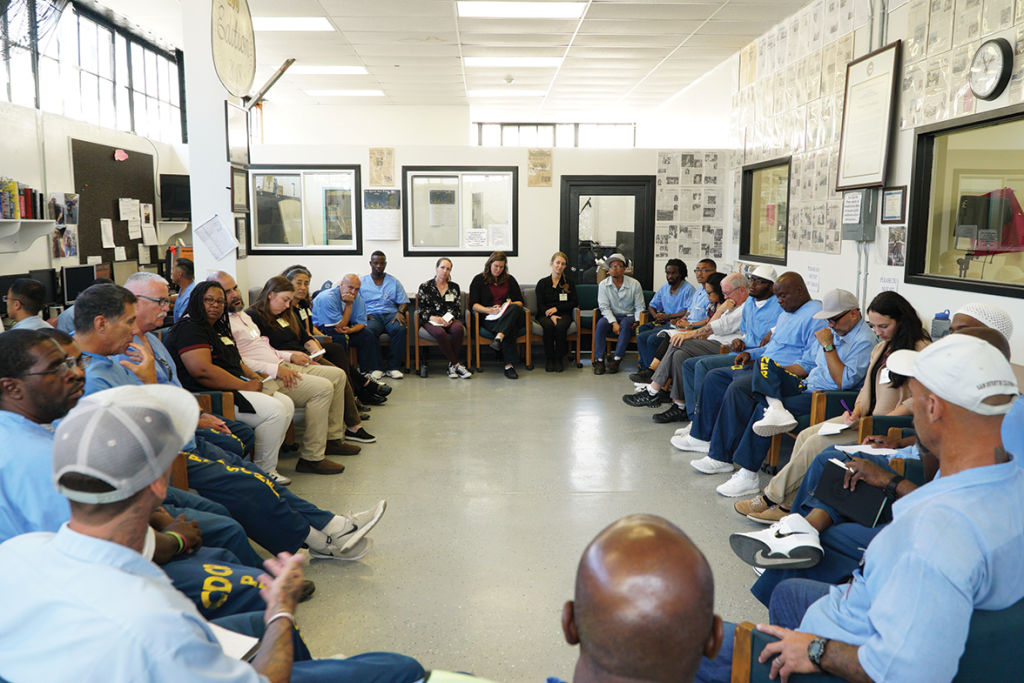
One of the first things I noticed when I began teaching at San Quentin in September 2018 was the remarkable similarity to, well, any other classroom. Other than the razor wire visible from the window, and the padlocks on the metal cabinets that lined the back wall of the room, there wasn’t much about the space that made me immediately think, “prison.” There are, however, a few key differences, which I detail below. For information about the incarcerated population in the United States and in California specifically, please see the Guys in Blue.

At the time of writing this essay, I have taught both communication studies and pre-college English twice with the Prison University Project (PUP) at San Quentin State Prison. All of the classes offered by PUP meet twice per week and are team-taught by two or more instructors. Instructors of credit-level courses must hold an advanced degree (master’s or higher) in a closely related field, and instructors of pre-college courses must have a bachelor’s degree at minimum, with graduate experience preferred. 

Okay, there are a few differences

  • Students do not have computers. Students are unable to access the internet, and rely on printed materials from teachers or the prison’s library when collecting research. While some students have access to basic word processing programs through their jobs and can hand in typed work, many do not, and have to write their papers by hand.
  • Students cannot contact teachers directly. The institution’s rules do not allow students to contact teachers outside of class, and teachers cannot hold regular office hours.
  • Students sometimes miss class due to extenuating circumstances. Students may be called to a medical appointment or parole board hearing without having a say in the day or time of the appointment.
  • Lockdowns, quarantines, and unforeseen circumstances happen. In other words, classes might be canceled with very little notice, and teachers probably won’t know why. Or, teachers won’t be allowed into the prison if there is limited visibility due to the weather (fog, for instance, is a recurring problem).
  • The only technology available in the classroom is a TV/VCR/DVD player combination. No cell phones, no laptops, and no recording devices are allowed. All media shown in class must be approved in advance by the CDCR. .
Source: UC Santa Cruz

The students >>


Theory is great, but what do I do on Monday morning?

A shift in focus

The first time I taught English 99B, over this last summer, I focused primarily on student writing. I was nervous that discussing the readings would only serve to impose my agenda, or my interpretations, on students, and that caused a great deal of concern for me. I didn’t want to tell them what meaning to make of the readings, but I didn’t know how to address teaching reading without doing just that. So, I focused heavily on writing because I felt that I was ill-equipped to offer varying perspectives on the readings and therefore did not offer students very much in terms of reading assistance. My course uses curriculum that was developed specifically for the PUP preparatory program by someone who has more teaching experience than I do, so I tend to defer to the assignments that have been paired with the readings in the past.

Click for more information about PUP’s College Prep program.

Where to start?

Teaching the English 99B course for the second time during this current semester has been a vastly different experience than the first time. Using facets of the many theoretical approaches detailed in our ENG 701 readings has provided an incredibly useful foundation on which to help students develop reading strategies.

One of my main goals in the 99B course, I realized, is to facilitate student learning in terms of transferable knowledge and prepare students not only for English 101A, but for future courses. When I read Tara Lockhart and Mary Soliday’s article, The Critical Place of Reading in Writing Transfer (2016), I decided that I needed to be a more active facilitator of developing student reading practices in order to help students develop valuable skills that will be useful as they move forward in their college careers, as well as improve confidence in their writing skills. I’m also always worried about resorting to the same methods that Adler-Kassner and Estrem warn against in Reading Practices in the Writing Classroom: seeing students as passive learners, conveying the meaning of texts rather than helping students develop ways in which to engage with texts.

Not to mention, students might even find their readings more interesting if they were shown multiple ways in which to engage with the texts.

As a relatively new teacher, I find that I often lack the experience needed to effectively scaffold my ambitious ideas, so I knew I’d need to begin with smaller exercises rather than high-stakes projects. I began with one of the sample assignments that Dr. Sugie Goen-Salter had graciously shared with our class, a guided annotation exercise, and completed it as I read the next week’s assigned reading, Sonny’s Blues by James Baldwin. In our next class, I handed out both the blank template and my own completed annotations as an example. In the past, I’ve been hesitant to offer my own work as examples of assignments, worried that I was assuming a voice of authority, but I’ve learned that sometimes, I need to prioritize guidance over worrying excessively about whether or not my interpretation is the best possible example. So, off I went.

I was encouraged when several of the students asked me for more copies of the guided annotation assignment to use in the next weeks’ readings. Because stars had somehow aligned and the now-infamous short story, Bloodchild by Octavia Butler, was assigned for the next week, I decided there was no better time to introduce the difficulty paper, another sample assignment shared by Sugie.

I should pause for a moment and mention that several students in my previous English 99B class over the summer had a hard time with this particular text. The students were offended by the reversal of gender roles and generally unhappy that a “feminist” author had been assigned in an English class, and I was unprepared in terms of framing and scaffolding. It was a blip in an otherwise smooth semester, and I was determined to do better the second time around.

Reading ‘Bloodchild’

So, this semester I decided that instead of having the students read Bloodchild outside of class, we would read the story aloud in-class. Before distributing the difficulty paper and beginning to read the story, I provided students with my adaptation of my high school English teacher’s introduction to the feminist literary perspective. The purpose of this introduction was an effort to reassure students that I wasn’t trying to make them dive head-first into the feminist perspective.

Then, we read Bloodchild in its creepy, disturbing entirety out loud; each student (including one of my students from my communication studies course, who decided to sit in on the class that day when he heard we were talking about feminism), our TA, and I read a page of the story. Once we had completed the story, the students spent 10 minutes writing about the difficulties they had experienced with the text: everything from confusion in understanding the relationships between the characters to implications around gender and power dynamics.

Rather than attempting to somehow convince students that their perspectives were incorrect, or that they were correct, or that my reading was somehow more valid because I was the teacher, the difficulty paper assignment allowed us to identify and discuss, as a class, components of the text that were problematic. We used the “believing game” to consider how gender roles could have played a part in the story (meaning, taking a hypothetical stance on an issue rather than necessarily arguing one’s true viewpoint). This provided students a platform on which to engage with the text and consider a perspective that they may not have otherwise been able to recognize. It also, hopefully, provided a tool that will help them in future English courses and across the disciplines.

Willingness to engage, even if the student doesn’t necessarily agree with or even understand the author’s message, is a crucial part of participation in a community. Willingness to push through, to continue despite tension, can determine the difference between whether or not a student completes a class. Helping students explore ways in which to persist through these challenges is crucial to student success, both in the classroom and beyond.


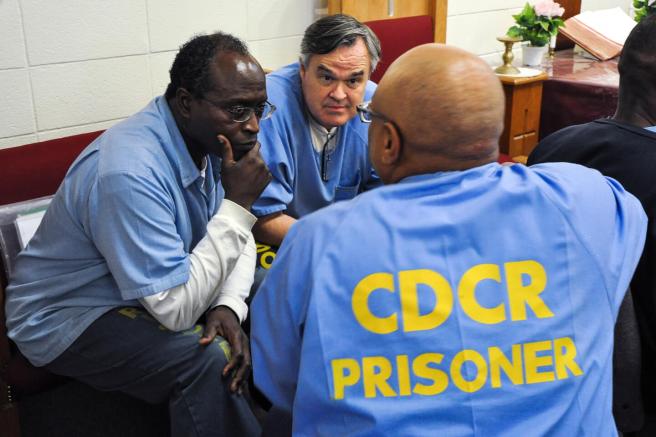
The Guys in Blue: Students at San Quentin State Prison

Source: the Bold Italic

Students in English 99B, Fall 2019

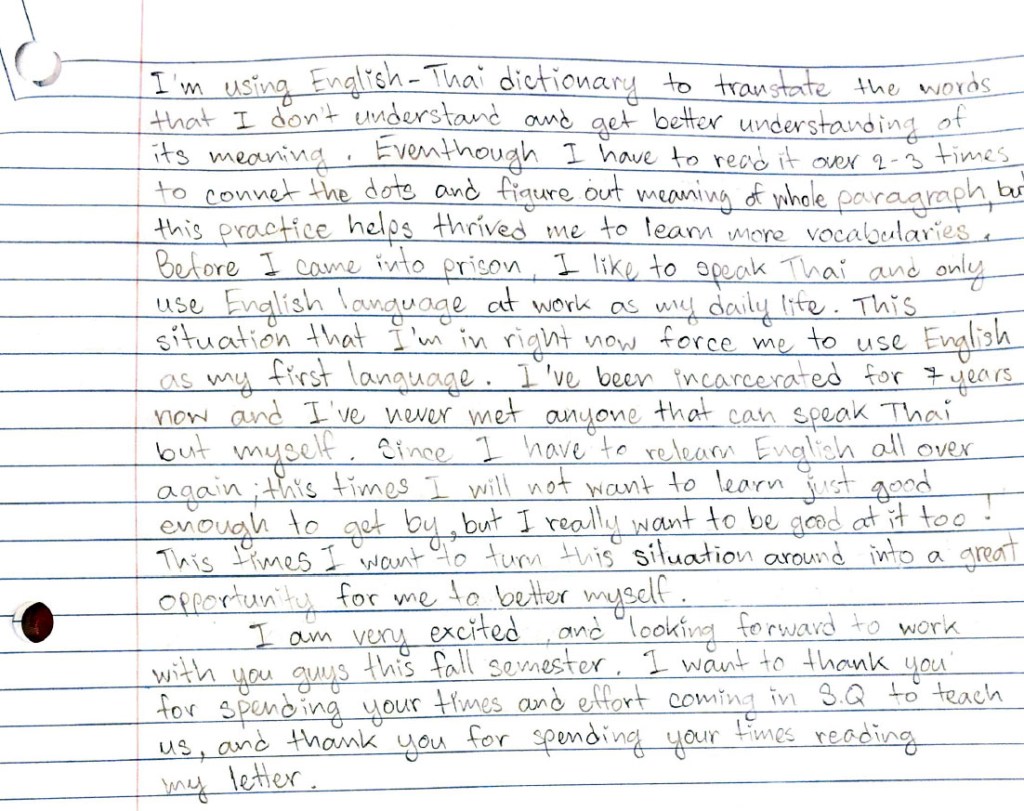
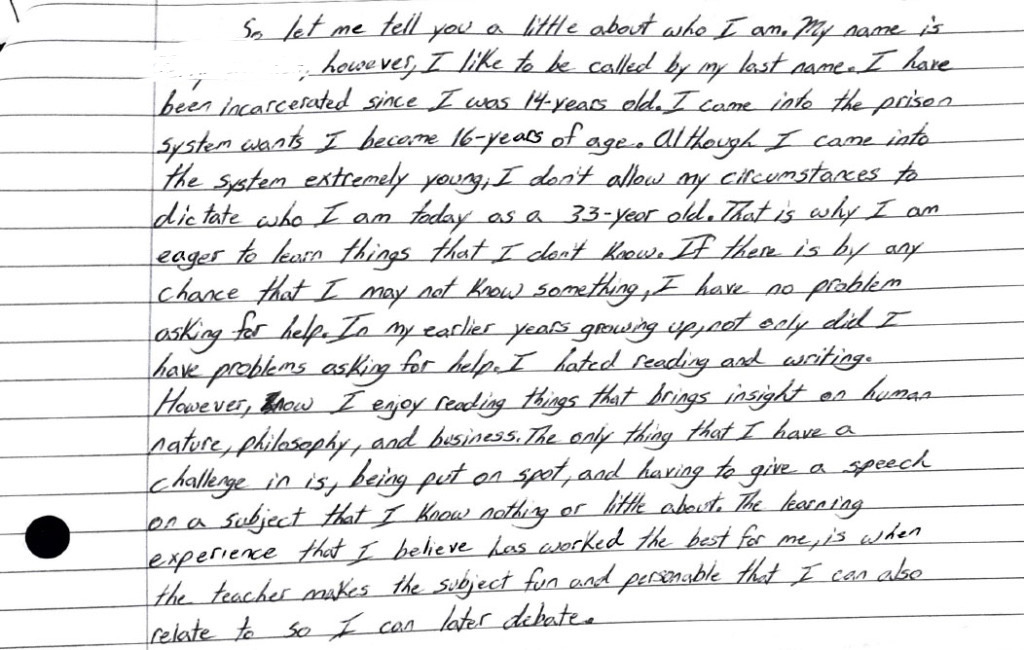
The following examples of student work are offered to provide readers with an idea of San Quentin students’ backgrounds, which are vastly diverse. I feel that acknowledging my privilege as a non-incarcerated person is important here, because I’m speaking for students who can’t simply type up a blog post and make it public. Therefore, I want to represent a few students’ words as they chose to convey their own messages to my co-instructor and myself (with permission from students).

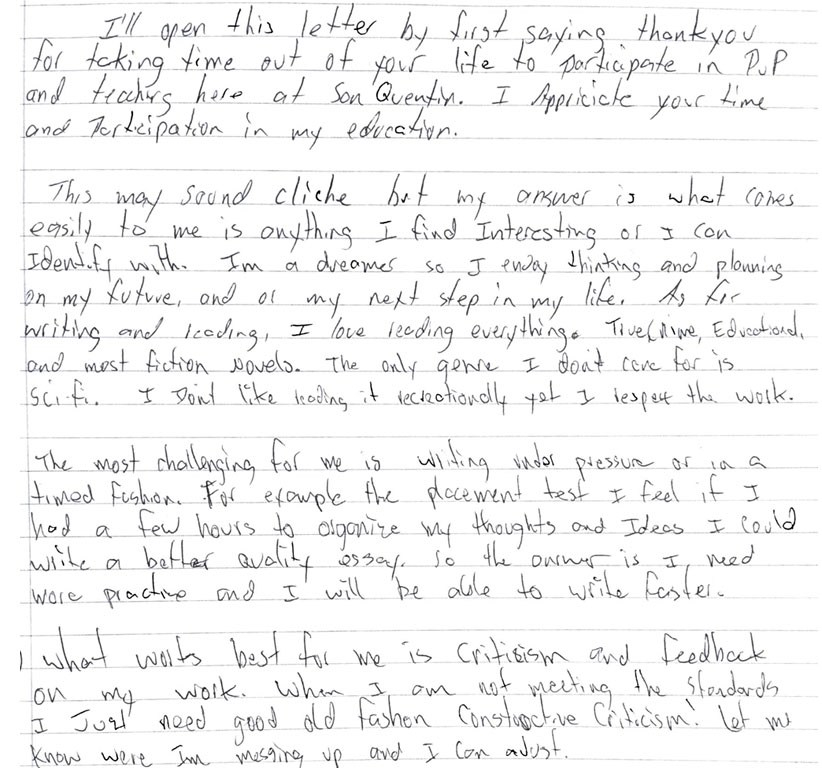
One of our first assignments of the semester invites students to write a letter to us, their teachers. Students are prompted to share their challenges and successes in learning, prior education experiences, and their reading and writing practices in everyday life. These letters are useful for several reasons, one of which is that students are invited to share more about themselves than their obvious status as an incarcerated person. I think that this not only allows teachers to see students as complex humans (rather than inmates) but it allows students to draw attention to their own lived experiences and see these as both valuable and relevant in a classroom context. In these letters, I learned that one of my students is currently writing a novel that takes place in Hong Kong, another was born in Thailand and worked as a sushi chef in Hollywood for several years. One student is married to a middle school teacher and attended Cal Poly where he majored in engineering. Another just completed his GED and wasn’t so sure about this whole college thing. The letters allow us to read our students as people, to see beyond the state-issued blue shirts and recognize the vast differences between each person.


Note: I want to call attention to the fact that, because incarcerated students do not have access to the internet, they are unable to access this digital essay. I have compiled all of its components into a formatted PDF, so that it can be easily printed in its entirety for incarcerated students. This is not a perfect solution, but I felt that it was a necessary step toward equitable access to education.

The articles and reports that are accessible through the hyperlinks in the text of this essay give readers access to printable documents that could be shared. All of the hyperlinked articles are stored on my Google Drive.


The writing shared is posted with explicit permission from students, who were provided with a description of this assignment and an explanation of the context in which their words would be used. Any student whose name appears here gave explicit permission (and in some cases, requested) to have his full name included with his work.

J.D.

J.D.’s letter to his teachers, Fall 2019

T.K.

TK’s letter to his teachers, Fall 2019

P.K.

N.B.


The prison population at San Quentin State Prison

  • 4,198 men are housed at San Quentin (weekly report , CDCR, 12/4/2019.) (“Men” refers to individuals who are considered by the state to be biologically male because of sex assigned at birth)

The prison population in California

According to the PPIC (Public Policy Institute of California)’s report published in 2019:

  • Approximately 115,000 people are housed in California’s 35 state prisons
  • 28.5% of adult men incarcerated in California are Black, which is 4,236 per 100,000 people (the imprisonment rate for white men is 422 per 100,000)
  • 25.9% of incarcerated women are Black (5,849 women are imprisoned in California, total)

The prison population in the United States

According to a report published by the Sentencing Project in 2019:

  • 2.2 million people are incarcerated in the United States
  • 60% of the incarcerated population are people of color
  • Approximately 1 out of 12 Black men in their thirties is in prison or jail
  • Black men are 6 times more likely than white men to experience incarceration
  • Hispanic men are 2.7 times more likely to experience incarceration than white men

One Room, Many Worlds

Navigation

This project is an attempt to synthesize my experience teaching preparatory English in San Quentin State Prison, while enrolled in English 701: Theoretical Backgrounds in Community College Reading at San Francisco State University.

Under the presumption that literacy can lead to empowerment, the information included here discusses my integration of what I’ve learned in English 701 into the preparatory English class, which I refer to here as “English 99B”, that I teach at San Quentin. In doing so, I propose that student learning improves when students are given the tools with which to relate the texts from class to their lived experiences.

Content is as follows:

Sources – One Room, Many Worlds